Translate:
Ògbóni

Discover Consejo Cultural Yoruba de Canada
Ògbóni
Ògbóni in Early Yorùbá Society
Structure, Authority, and Dual Sacred Lineages
In early Yorùbá society, Ifá was not originally conceived as a “religion” in the modern sense, but rather as a comprehensive system of knowledge, divination, and cosmological insight. Similarly, Òrìṣà worship was primarily organized at the compound (ilé) level, with each lineage maintaining its own deities, rituals, and ancestral practices. Ogbó"* in Ifẹ̀ and other Yoruba dialects carries the sense of "aged," "elder," or "matured." - "Eni" means "person" or "people." So Ogboni = "aged ones" or "wise elders."
Originally it wasn't just the name of the famous secret society. In many Yoruba towns, especially Ifẹ̀, ogboni could refer broadly to any council of senior elders who held sacred or judicial authority. They were the ones who settled disputes, protected and kept sacred information or objects as custodians of esoteric and powerful information, upheld customs, and mediated between the king, the people, and the ancestors.
Over time the term got attached most strongly to the Ògbóni fraternity/Ẹdan, the powerful sociopolitical and religious institution that spread from Ilé-Ifẹ̀ to other Yoruba kingdoms. That group became the “ Ògbóni ” with a capital O, with its bronze edan figures, earth worship, and role as a check on the Ọba’s power.
But today, Ògbóni as a society has evolved from a generic elder council into the formal fraternity and platform that carries more systemic spiritual ideology.
Within this decentralized spiritual environment, Ògbóni emerged as a unifying and stabilizing institution, providing structure, continuity, and higher-order authority.
🔱 Core Functions of Ògbóni
1. Unification of Òrìṣà Practice
Ogboni served as a centralizing force, harmonizing diverse forms of Òrìṣà worship without eliminating local autonomy. It provided:
Structural cohesion
Ritual continuity
Shared ethical and cosmological alignment
2. Institutional and Spiritual Governance
Ogboni functioned as a sacred governing body, offering:
Oversight of tradition and ritual integrity
A framework for leadership and responsibility
A structured system through which individuals and communities could operate
3. Balance of Political Power
Ogboni played a critical role in maintaining equilibrium between spiritual and political authority:
Acting as a check on the power of Obas (kings)
Affirming or legitimizing rulership through spiritual authority
Ensuring governance aligned with cosmic order (Àṣẹ) and the will of Ilẹ̀ (Earth)
4. Custodians of Esoteric Knowledge
Ogboni were recognized as guardians of sacred knowledge and instruments, including:
Esoteric teachings
Ritual technologies
Sacred symbols such as Edan Ogboni
🏛️ Pre-Odùduwà Ifẹ̀: Dual Ogboni Lineages
Historical traditions of pre-Odùduwà Ilé-Ifẹ̀ indicate the existence of two distinct Ogboni lineages, each representing a different orientation of primordial authority:
🔸 Ogboni Olúfẹ́ — The Earth-Centered Covenant
This lineage reflects what later becomes the classical Ogboni system, grounded in the authority of the Earth.
🧿 Core Focus:
Onílẹ̀ (Owner of the Earth) → primordial ground, moral witness, and final judge
Edan Ogboni → sacred instrument embodying:
Truth
Law
Covenant
Collective authority
🔱 Orientation:
The Earth (Ilẹ̀) is the central axis of order and justice
Edan serves as a binding force between members and the Earth
Emphasis on:
Social balance
Moral accountability
Institutional stability
👉 This represents a juridical, stabilizing, and governance-oriented expression of Ogboni power
🔸 Ogboni Arapa-Nika — The Primordial Mother Current
This lineage reflects a deeper esoteric current, rooted in primordial feminine power.
🧿 Core Focus:
Ìyáàmi Òṣòròngà (The Great Mothers) → source of mystical force, generative power, and unseen authority
Edan Ogboni → understood as:
A messenger of Ìyáàmi
An extension of her perception
An “eye” (Ojù) through which the unseen realm observes and acts
🔱 Orientation:
Power originates from the primordial feminine source
Emphasis on:
Mystical authority
Spiritual surveillance
Transformation and unseen influence
👉 In this current, Edan is not only a symbol of law—it is a living conduit of perception and power, functioning as an eye of the unseen realm
🔥 Synthesis
These two lineages are not oppositional—they represent complementary dimensions of the same sacred system:
Onílẹ̀ provides the ground of order.
Ìyáàmi provides the source of power.
Edan stands between them as both covenant and eye
What happened to Ogboni Arapa-Nika!
The fallout between Ogboni Olufẹ and Ogboni Arapanika also know as the strive between Ẹlẹyẹ / Ìyámi Àjẹ́ cult and Obatala’s rulership, which in some accounts sparked one of Ifẹ’s earliest civil conflicts.
1. The strife that started in Ejigbomẹkun market
Ejigbomẹkun is remembered in Ifẹ oral history as one of the ancient markets, tied to the Ẹlẹyẹ — the “owners of birds,” a euphemism for Ìyámi Òṣòrọ̀ngà / Àjẹ́. Markets are spiritually charged spaces in Yoruba cosmology, and disputes there often escalated beyond trade. In this account, a clash between human authorities and the Ẹlẹyẹ destabilized Ifẹ’s political balance.
2. Civil war in Ilé-Ifẹ̀
The tension escalated into civil war. On one side was the reigning Olúfẹ̀ Ọbatálá — Obatala as king of Ifẹ̀, associated with peace, purity, and the Ogboni/Ògbóni fraternity in its earliest form. On the other was Iyagirimoko / Idagirimoko, a powerful priestess-leader aligned with the Ìyámi. The war was devastating — “many souls were lost and many deaths recorded.”
3. The exile to Ọ̀tà
After Ọbatálá’s forces prevailed, Iyagirimoko and her followers, devotees of Ìyámi, emigrated from Ifẹ̀. Tradition says they settled in present-day Ọ̀tà, Ogun State, where Ìyámi worship remains strong to this day. Ọ̀tà is still regarded as a major Ìyámi / Gelede spiritual center.
4. End of “Ogboni Arapanika” from Ifẹ̀
“Ogboni Arapanika” refers to the primordial Ogboni of the iyami worshippers before its later institutionalization. The war marked a break: the esoteric, Ẹlẹyẹ-aligned faction left, and Ogboni in Ifẹ̀ reorganized under Ọbatálá’s ethos of rulership — order and calm. Some traditions say this is why certain Ìyámi mysteries are now “exiled” knowledge, centered outside Ifẹ̀.
This marks the end of Ogboni Arapa-Nika as Ogboni Olufẹ consolidated it's power, admits into it's rank some remnant of Arapa-Nika but as an outside of 'Ile mọlẹ' not as a member of the 13 man Ògbóni Olufẹ.
ERIWOYA!!! ERIWOYA!!! ERIWOYA!!! EPA, EPA, EPA Mole!!!
Mo múlé t'Osó,
Mo mẹ́yìkùlé t'àbíyè,
Àyàjọ́ ọjọ́ ìmùlẹ̀ n'ífẹ̀,
N'ígbójé ẹlùjú Méfà.
A Historic Milestone for Ogboni in Canada
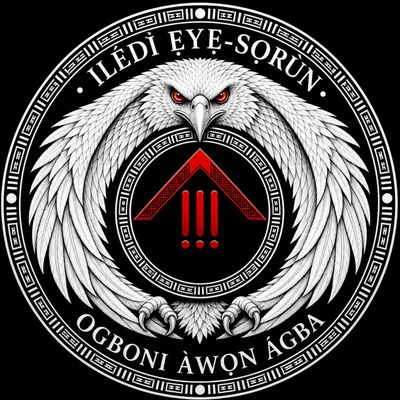
It is with profound gratitude and humility that we announce the founding of Ilédì Ẹyẹ́ Sọrun (Iledi Eyesorun) on July 5, 2026.
Established under the sacred lineage of Ogboni Àwọn Àgbà, the Mystic Lodge of the Astral Rulers is comprised of twelve Founding Members and is headquartered in Erin, Ontario, Canada.
This marks a historic milestone as the first Ogboni Lodge in Canada established under the Ogboni Àwọn Àgbà lineage.
Our founding is dedicated to preserving and transmitting the sacred wisdom, ethical principles, ancestral teachings, and spiritual disciplines of Ogboni while fostering unity, integrity, wisdom, and service within our community and for future generations.
We offer our deepest appreciation to our revered elders, teachers, and all those whose sacrifices and guidance have made this historic moment possible. May the wisdom of our ancestors continue to illuminate our path, and may the work of the Lodge always be carried out with truth, humility, and unwavering commitment.
Ogbo Àtọ̀! Ogbo Ẹ̀dàn!
Truth endures. Wisdom prevails. The Ancestors bear witness.
/!!!\/!!!\/!!!\/!!!\/!!!\/!!!\/!!!\
**Mo múlé t'Osó,**
**Mo mẹ́yìkùlé t'àbíyè,**
**Àyàjọ́ ọjọ́ ìmùlẹ̀ n'ífẹ̀,**
**N'ígbójé ẹlùjú Méfà.**
---
## **Un momento histórico para Ogboni en Canadá**
Con profunda gratitud y humildad, anunciamos la fundación de **Ilédì Ẹyẹ́ Sọrun (Iledi Eyesorun)** el **5 de julio de 2026**.
Establecida bajo el linaje sagrado de **Ogboni Àwọn Àgbà**, la **Logia Mística de los Gobernantes Astrales** está compuesta por **doce Miembros Fundadores** y tiene su sede en **Erin, Ontario, Canadá**.
Este momento marca un hito histórico como **la primera Logia Ogboni en Canadá establecida bajo el linaje de Ogboni Àwọn Àgbà**.
Nuestra fundación está dedicada a preservar y transmitir la sabiduría sagrada, los principios éticos, las enseñanzas ancestrales y las disciplinas espirituales de Ogboni, fomentando al mismo tiempo la unidad, la integridad, la sabiduría y el servicio dentro de nuestra comunidad y para las futuras generaciones.
Expresamos nuestro más profundo agradecimiento a nuestros venerados mayores, maestros y a todos aquellos cuyos sacrificios y guía han hecho posible este momento histórico. Que la sabiduría de nuestros ancestros continúe iluminando nuestro camino, y que el trabajo de la Logia siempre se realice con verdad, humildad y compromiso inquebrantable.
**Ogbo Àtọ̀! Ogbo Ẹ̀dàn!**
*La verdad perdura. La sabiduría prevalece. Los Ancestros dan testimonio.*
/!!!\/!!!\/!!!\/!!!\/!!!\/!!!\/!!!\
**Mo múlé t'Osó,**
**Mo mẹ́yìkùlé t'àbíyè,**
**Àyàjọ́ ọjọ́ ìmùlẹ̀ n'ífẹ̀,**
**N'ígbójé ẹlùjú Méfà.**
---
## **Une étape historique pour Ogboni au Canada**
C'est avec une profonde gratitude et une grande humilité que nous annonçons la fondation de **Ilédì Ẹyẹ́ Sọrun (Iledi Eyesorun)** le **5 juillet 2026**.
Fondée sous la lignée sacrée de **Ogboni Àwọn Àgbà**, la **Loge Mystique des Gouverneurs Astraux** est composée de **douze membres fondateurs** et est établie à **Erin, Ontario, Canada**.
Cette fondation marque une étape historique puisqu'il s'agit de **la première Loge Ogboni au Canada établie sous la lignée de Ogboni Àwọn Àgbà**.
Notre Loge est consacrée à la préservation et à la transmission de la sagesse sacrée, des principes éthiques, des enseignements ancestraux et des disciplines spirituelles d'Ogboni, tout en favorisant l'unité, l'intégrité, la sagesse et le service envers notre communauté et les générations futures.
Nous exprimons notre plus profonde reconnaissance à nos aînés vénérés, à nos maîtres et à toutes les personnes dont les sacrifices, le dévouement et les conseils ont rendu ce moment historique possible. Puisse la sagesse de nos ancêtres continuer à éclairer notre chemin, et que les travaux de la Loge soient toujours accomplis dans la vérité, l'humilité et un engagement indéfectible.
**Ogbo Àtọ̀! Ogbo Ẹ̀dàn!**
*La vérité demeure. La sagesse triomphe. Les Ancêtres en sont témoins.*
Òrìṣà Edan and the Ogboni or Osugbo cult
Òrìṣà Edan
Òrìṣà Edan cannot be discussed in isolation without discussing Ogboni cult. Ogboni cult cannot be discussed without discussing Òrìṣà Edan, the two entities are intertwined and interdependent. But Òrìṣà Edan is the Òrìṣà (spiritual force or the deity) while members of Ogboni or Osugbo cult are the followers or worshiper of the Òrìṣà Edan.
WORLD BEFORE THE EXISTENCE OF ÒRÌṢÀ EDAN AND OGBONI OR OSUGBO CULT.
In ancient times in Yorubaland, as evidenced by Ifá sacred scriptural verse and oral historical facts, there was nothing like Ogboni cult or society in existence. Even Òrìṣà Edan was in Isalu Orun (heaven), she had not come down to the Isalu aye (earth) with her contemporaries Irúnmọlè (deities). As Ifá sacred scripture points it out, that during this period there was chaos in the world. There was oppression of the weak by the strong. There was injustice. The king and Ruler abused their power with no one to check them. Everything was in state of total disarray. This is what prompted Òrúnmìlà to cast Ifá divination reading to find a solution to the problem or how the world could be peaceful and orderly. The Odu Ifá that appear on Ifá divination tray (Opon Ifá) that day was:
ÒGÚNDÁ MÉJÌ
I I
I I
I I
II II
It is in this Odu Ifá that Ifá instructs Òrúnmìlà to invite Òrìṣà Edan from Ikole Orun (heaven) to come to Ikole aye (earth) to bring peace, justice, orderliness and good governance to the world. This can be deduce from Odu Ifá ÒGÚNDÁ MÉJÌ I cited above where Ifá says:
Ololo babalawo Edan
lo dIfá fun Edan
A ki gbo iku Edan
Yooro lEdan ma n se
Oluto aye si wa lona
AdIfá fun Òrúnmìlà, abu fun Edan
Eyi ti yi o to Ile aye
Bi Eni to afoku igba
Gbogbo aye to Ile aye ti paabo ni o jasi
Se ni won fa Ile aye ya perepe afoku igba
Òrúnmìlà lo si ode Orun
O pe Edan ojugba re wa sile aye
Ebo ni won ni ki won se
Won rubo
Ebo lo gba wa kale a ri eyin iku
Ebo ni o gba wa kale areyin Arun
Ebo lo gba wa kale areyin gbogbo ogun
Translation
Ololo is the Ifá priest of Edan
Cast Ifá divination reading for Edan
We will never hear of Edan's death
Edan always live long in good health
The peace maker of the world is still on her way
Cast Ifá divination reading for Òrúnmìlà and his contemporary Edan
One who will fix the world
As if fixing a broken calabash
The people try to fix the world, alas all their efforts is abortive
Instead they broke the world like a broken calabash
Òrúnmìlà then went to heaven to bring Edan his contemporary
They were both instructed to carry out sacrifice wish they did.
It is the sacrifice that save us we overcome death
It is the sacrifice that save us we overcome diseases
It is the sacrifice that save us we overcome all life difficulties.
It is clear from the Ifá scriptural verse above that Òrìṣà Edan was invited by Òrúnmìlà to this world to bring peace and stability to this world. Òrìṣà Edan came to this world at Òrúnmìlà’s request. On Edan’s arrival to Isalu aye (world) she brought with her a system of justice, law enforcement, fairness and equity. Her major method in achieving this is through a method where sages and elderly knowledgeable member of the community were selected or chosen to over see the affair of each community. These people are the ones who see to that there be peaceful co-existence among peoples, they prevent oppression, they provide checks and balance to the ruler and the ruled. This group of people is nicknamed as Ogboni or Osugbo.

Ogboni, Isese lagba, Ifa-Orisa, Yoruba